
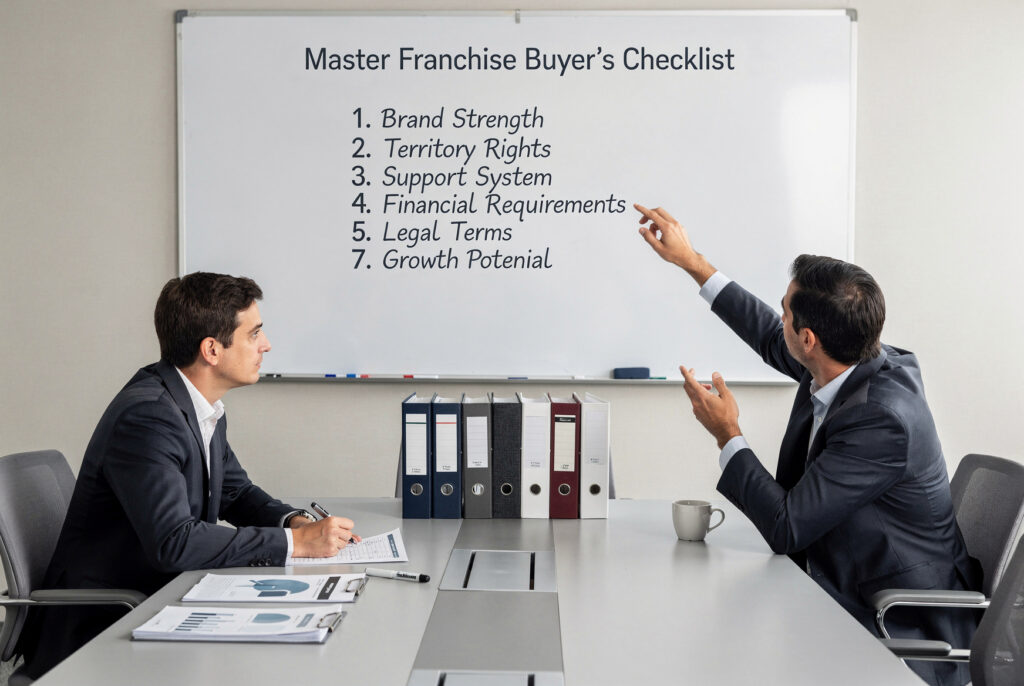
Quick answer: Before you buy a master franchise, evaluate seven things: (1) territory exclusivity and protection, (2) the development schedule and quotas, (3) the Franchise Disclosure Document, (4) the revenue model and fee split, (5) the franchisor's stability and support, (6) the legal terms in your agreement, and (7) validation from current operators. Each one protects your territory, your capital, and your results over a 10 to 20 year commitment.
When you buy a master franchise, you move from local owner to regional leader. This is not a typical business purchase. You are taking on the responsibility, and the reward, of building an entire market. The details you check now shape your results for the next 10 or 20 years.
Before making this investment, review seven fundamentals. Each one protects your territory, your capital, and your long-term results:
Use this checklist to protect your investment before any commitment or payment.
A master franchise gives you regional development rights. You expand our brand in a protected area by recruiting, training, and supporting unit franchisees, and you become a revenue partner who earns on every contract in your territory.
In the Stratus Clean master franchise model, your entire focus is on building your business, not performing cleaning. We set you up as the infrastructure for a multi-million-dollar territory. As we say, "You are the organization behind the operators."
This is a significant executive decision. You are acquiring rights over a region, investing at a larger scale, and taking responsibility for the performance of unit franchisees. Brand, economics, legal safeguards, and support all must meet your standards.
You must validate both the brand and the financial opportunity. The key sections of the FDD, the legal agreements, and feedback from current operators are what protect you.
The best opportunities share seven traits, and they map directly to the checklist below:
Each one lets you scale with clarity and confidence.
World-class master franchises offer:
Always get precise geography and terms upfront. Ask whether reserved or national accounts exist and what territory access, if any, the franchisor keeps. According to Lopes Law, verify whether your exclusivity is complete or subject to exceptions.
You want a territory built on high commercial activity and business growth. Pressure-test the population, office and retail density, recent growth, and demand categories such as schools, medical, retail, industrial, and professional services. At Stratus we use both population and commercial-facility counts. Available markets only open to master candidates for a limited time.
Clarity matters. If you miss development targets, your exclusivity, or even your territory rights, can change. Lopes Law states that missed milestones can result in "reduction, loss of exclusivity, or full termination." Get those rules in writing.
Your quota defines your business pace and protects your rights. Know the exact milestones, unit openings, and timing. If the schedule slips, growth slows and your rights may be affected.
Quotas often require 10 to 50 units in your first decade. Lopes Law describes development requirements as your top business risk, because falling short can cost you territory. Review every timeline and milestone with your advisors.
Map demand, recruiting, capital, and training capacity to the quota. A healthy ramp is more than a spreadsheet projection, and your executive skill here shapes the outcome.
Expect strong recruiting and onboarding support. Look for sales programs, top-tier marketing, national accounts, and franchisee-development tools. At Stratus, you gain access to dedicated recruiting resources as you scale.
Zero in on the following FDD items. Each one signals transparency, strength, and alignment with your financial interests:
Federal law requires every franchisor to give you the FDD at least 14 days in advance. Here is how the FDD protects you, and the FTC guide gets specific too.
All startup costs, license fees, and working-capital requirements appear here. Review them with your accountant and make sure you have two years of runway. Overestimate as a safeguard.
All earnings claims must be backed up here. The absence of an Item 19 means the franchisor makes no verified earnings claims. Stratus offers detailed, region-level data for full transparency, always contextualized and never as a guarantee.
Check for lawsuits, especially any involving unfair practices or disputes with master owners. Review closure rates as a signal of support and economics. Audited financials tell you whether the brand can deliver the training and resources you expect.
Your earnings come from unit franchise fees, recurring royalties, and defined system revenues. Confirm every stream, split, and timing in the FDD and agreement.
Franchise fees pay upfront. Royalties grow steadily as your franchisee base expands. A mature territory produces a reliable, growing revenue base.
Royalties are typically shared 50 to 60 percent to you and 40 to 50 percent to the franchisor, though this varies by system, so confirm the exact split in the FDD. Across the industry, master or territory fees commonly range from $100,000 to $500,000 depending on territory size and commercial opportunity (Lopes Law). At Stratus, the master fee averages about $125,000, with a typical total investment of $275,000 to $300,000 including roughly $150,000 in working capital. Always verify current figures in our FDD.
Stratus provides a robust recurring model, with over 90 percent of revenue recurring monthly.
Rely only on Item 7 and Item 19, plus your own independent projections. Take no informal promises. Share your model with a franchise or financial advisor before you act.
Top systems offer full executive training, current technology, marketing infrastructure, and profit-focused franchisee support. You build value through network performance, so franchisor support equals territory growth.
Stratus stands out for executive-focused onboarding. Pre-opening, headquarters, and territory-based training covers marketing, sales, accounting, and management. View our training program.
Our proprietary StratusConnect app enables seamless operations. Advanced technology multiplies your management leverage and drives results territory-wide.
You benefit from a robust national program and local marketing tools. Stratus supplies targeted support to help you win accounts and grow territory share.
Only sign if duties are spelled out, not just discussed on calls. Insist on documented manuals, onboarding, and support schedules. Our agreements leave nothing to chance.
Insist that your master franchise agreement gives you:
Have your attorney review every page. The FTC recommends specialists in franchise law for this work.
Length varies, but 10 to 20 years is typical. Renewal rights may include fee or program changes, so make sure these are clear before you proceed.
Your territory is an asset. Resale standards and buyer criteria should be specific and written, with no open-ended discretion by the franchisor.
If the agreement ends, know what happens to your sub-franchisees and accounts. Your revenue and reputation depend on structured outcomes.
Solid agreements specify non-compete scope, timing, and geography. Confirm enforceability with your legal team.
Operator feedback is your reality check. The FTC calls these conversations "the most reliable way" to verify system promises.
Connect with current masters about training, ramp speed, support, technology, franchisee recruitment, and profit stability. Our process includes these calls for every candidate.
Talk to former masters for candid insight into challenges and their paths forward. Learn why they changed course and what they would do now.
Use impartial third-party research such as Franchise Business Review. Stratus ranks high, with 86 percent of current masters saying they would reinvest. Treat all numbers as indicators, not guarantees.
Master franchising rewards those with recruiting, coaching, and growth experience. You do not need cleaning expertise. Our leadership spans education, sales, insurance, engineering, and retail. Confirm you have the executive mindset, capital, and vision to own your region.
Only sign after you have met every step and read the FDD for the full required period. For a clear, practical overview, start with our Stratus Clean FAQs.
How much does a master franchise cost? Costs depend on the region and the brand, and Item 7 of the FDD has the final word. For Stratus Clean, the typical investment runs $275,000 to $300,000. This includes an average $125,000 master fee and about $150,000 in working capital. Always check our current FDD.
What is the difference between Item 7 and Item 19 in the FDD? Item 7 details your startup investment. Item 19 shows financial performance representations. One protects your outlay, and the other provides context on verified earnings and ramp.
How long is a master franchise agreement? Most master franchise contracts run 10 to 20 years. Renewal terms and rights vary, and your agreement defines all deadlines and conditions.
Should I hire a franchise attorney before signing? Yes. Only an experienced franchise attorney will properly cover the FDD details, territory, growth targets, renewal and exit options, and the legal protection you need. The FTC strongly urges the use of specialists.
Do you need cleaning experience to own a commercial cleaning master franchise? No. You succeed through business development, recruiting, and leadership. More than half of our masters joined with zero cleaning experience. You add value as a builder, not a hands-on operator.
The best outcomes flow from professional preparation. Review every territory, FDD item, financial model, legal safeguard, operator reference, and support promise before you sign. You will move forward knowing you control every key lever.
Stratus Clean is an executive-driven franchise platform. We lead with proven territory protection, nine recurring revenue streams, and structured support. Take the next step: review available territories, explore our support programs, or contact Rob Lancit, VP of Franchise Development, at (516) 551-4773 in the US, (604) 833-0911 in Canada, or rlancit@stratusclean.com. Let's build your region the confident, proven way.
© Copyright 2026. All Rights Reserved. Privacy Policy | Terms of Use | Site Map
